By the Cyber Make team · Last updated October 17, 2026
A 3D printer is at its most useful when it fixes small problems around the house. A hook in the right place, a drawer that finally stays tidy, a holder for the tool you can never find. This guide walks through useful prints room by room, with the filament to use for each one.
Quick answer: The most useful 3D prints for the home are small, functional items: cutlery dryers and dispensers for the kitchen, pen holders and organizers for the desk, hooks and labels for the house, tool holders for the workshop, and cable hangers for electronics. Print most of them in PETG for strength and moisture resistance, and use PLA for dry, indoor items.
Material choice matters more for functional prints than for decor. A pen holder will survive in any filament. A part that sits next to a sink, in a hot car or in the sun needs something tougher.
For strength, wall count matters more than infill. Three or four walls with 15–25% infill is a solid starting point for most household parts.
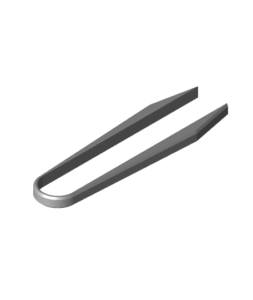
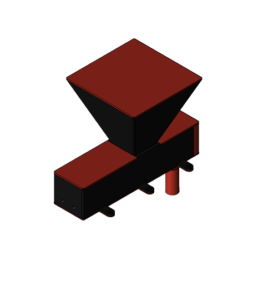
Kitchen prints solve daily annoyances: cutlery that never dries, sugar that spills, a bottle opener that disappears. Browse the full range in our kitchen STL files.
Print kitchen items in PETG. Water, warm air and soap are hard on PLA, and PETG wipes clean more easily. Keep everything out of the dishwasher unless you know your material can take the heat.
Treat 3D prints as not food safe by default. Layer lines trap food and bacteria, and many filaments, colorants and brass nozzles are not certified for food contact. For items that touch food, such as cookie cutters or tongs, use short contact only, wash by hand and replace them often. For anything that holds food or drink for a long time, add a food-grade coating or choose a non-printed alternative.
A tidy desk is one of the easiest wins for a new printer owner. Pen holders, caddies and stands print quickly, need few supports and are hard to get wrong. See all our desk and office STL files for more ideas.
PLA is fine for desk items because they stay dry and indoors. Print organizers upright with a 0.2 mm layer height. Use 0.12–0.16 mm if you want smoother curves on a decorative piece like a pencil holder shaped like a building.
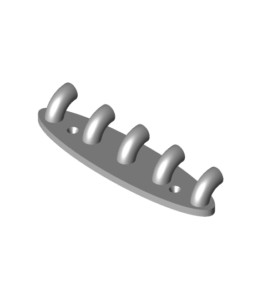
Household prints are the small parts that make a home run better: a key hook by the door, a dustpan, labels for the garden, a bird feeder for the yard. Our household STL files cover hooks, holders, storage helpers and replacement parts.
Wall hooks carry load, so orientation is important. Print hooks on their side, so the layers run along the curve instead of across it. A hook printed standing up can split along a layer line under weight.
Anything that goes outside, such as plant labels or bird feeders, should be PETG or ASA. PLA gets brittle and can warp after a summer in direct sun.
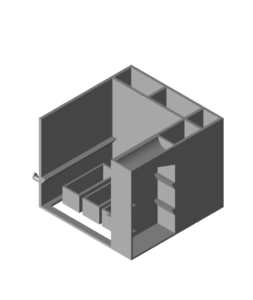
Workshop prints keep tools organized and sometimes become tools themselves. Wall holders, bit organizers and simple gauges are quick to print and save time every week. Find more in our tools and workshop STL files.
Use PETG for anything that holds heavy tools or sits in a cold or damp garage. Go up to four walls and 30–40% infill for holders that carry a load. For measuring aids like a radius gauge, print flat on the bed with a fine layer height so the edges stay accurate.
Cables, headphones and small devices create clutter fast. A desk-mounted cable hanger, reusable cable ties or a headphone hanger brings order in an afternoon. Browse our electronics and gadget STL files for cases, mounts and stands.
Electronics can get warm, so choose PETG for cases and mounts near chargers, routers or power bricks. For reusable cable ties, try TPU or PETG, since PLA tends to snap when bent repeatedly. Check the dimensions of any mount against your device before you print.
Most household parts are simple shapes, so you can often print them with no supports at all. Rotate the part so its largest flat face sits on the bed. That gives the best adhesion and the fewest overhangs.
When a part does need supports, such as the inside of a hook or a cable clip, try tree or organic supports. They use less filament and break away more cleanly than grid supports. Set a small gap between support and part so it peels off without damaging the surface.
For a quick test of fit, print at a 0.28 mm layer height first. Once the size is right, reprint at 0.2 mm for the final part. Keep the first layer slightly slower than the rest, around 20–30 mm/s, so wide, flat parts like trays and covers do not lift at the corners.
Scale decorative items freely, but be careful with parts that must fit something. Scaling a hook or a bottle cap changes the size of holes, threads and clips too. Measure the real object with a ruler or calipers, compare it with the model dimensions in your slicer and adjust only if they do not match.
Print times depend on your printer, size, layer height and infill. The table below gives typical ranges at a 0.2 mm layer height on a common FDM printer.
| Item type | Best filament | Typical print time |
|---|---|---|
| Cookie cutters and stamps | PLA or PETG (short food contact only) | 30 min – 1.5 h |
| Cutlery dryers, dispensers | PETG | 3 – 8 h |
| Pen holders, desk organizers | PLA | 2 – 6 h |
| Phone and tablet stands | PLA or PETG | 1 – 4 h |
| Wall hooks, key racks | PETG | 1 – 3 h |
| Garden labels, bird feeders | PETG or ASA | 1 – 6 h |
| Tool holders, bit organizers | PETG | 2 – 6 h |
| Cable ties and clips | TPU or PETG | 15 – 45 min |
| Device cases and mounts | PETG | 2 – 8 h |
New to printing? Start with our step-by-step guide to printing an STL file. If you are not sure what you are buying, read what an STL file is.
Start with a pen holder, a key hook or a cable clip. They print in a few hours or less, need little or no support and teach you the basics of orientation and settings.
PLA is strong enough for dry, indoor items that do not get hot, like desk organizers. For kitchens, bathrooms, cars or outdoor use, PETG is the better choice.
Most prints should be washed by hand. PLA can warp in a dishwasher, and even PETG can soften on a hot cycle. Hand washing also keeps layer lines cleaner.
You get a digital STL file to download and print on your own printer. No physical item is shipped. See our FAQ for details on downloads and file formats.